The British Film Institute has announced plans to appoint a single executive to run its production and distribution funds, with a combined annual budget of £21 million ($33 million).
This follows the resignation of Tanya Seghatchian as head of the BFI's film fund in September, and the departure of Peter Buckingham as head of distribution and exhibition in November.
These posts will be replaced by the newly-created role of film fund director, reporting to BFI chief executive Amanda Nevill.
This moves toward a more integrated policy of development, production and distribution investment, in line with the expected recommendations of the U.K. government's film policy review to be announced in January.
According to a BFI statement, the film fund director will be responsible for leading the existing production and distribution teams, nurturing filmmaking talent across the U.K., championing creative excellence and encouraging a bold approach.
The BFI took over from the U.K. Film Council in April as the public body responsible for investing lottery coin into British film production and distribution. Both Seghatchian and Buckingham moved from the UKFC to the BFI, but decided to leave once the transition was complete.
Wednesday, 14 December 2011

Wednesday, 9 November 2011
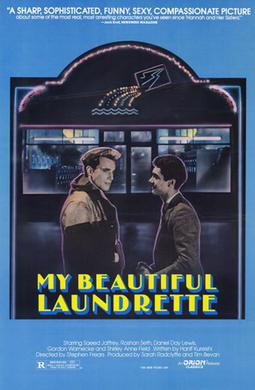
Borders and Belonging 'My Beautiful Laundrette'
Borders and Belonging ‘My Beautiful Laundrette’
‘My Beautiful Laundrette’ 1985, directed by Stephen Frears and written by Hanif Kureishi is a comedy drama, set in the suburban areas of London under Thatcher’s administration. The film’s narrative follows protagonist Omar (Gordon Warnecke), a second-generation Pakistani in Britain, who must bring his uncle Nasser’s failing laundrette to profit amid familial tensions and an unconventional relationship with Johnny (Daniel Day Lewis), a white national and punk. The film deals with social issues such as racism, homosexuality, identity and the economic climate’s effect on Britain.
From the very start of the film, it is explicitly implied it will centre on the idea of being one – or belonging within a community. We are introduced to Johnny and his fellow punk friend squatting in a house. The mise en scene of their costumes signifies the pair as outsiders – they are instantly identifiable as punks with their shaven ‘Mohican’ hairstyles and dark, leathery attire. Though the 80s were notorious for a rise in punk culture and gang communes, punks were still outcasts of society and not socially well-perceived – particularly under the conservative gaze of Thatcher’s government. And perhaps rightly so, due to these groups anti-social and often extremist right-wing political agenda. The nature of their eviction from their illegal residence is symbolic of this as they are driven out rather violently by antagonist Salim’s men. The fact Salim exerts more power in this particular scene – over that of Johnny is indicative of their changing times of Britain – the rising importance of capitalist ‘rat race’ and a decline in the importance of the race of the ‘rats’ involved. We are then introduced to Omar, who nurses over his drunkard father in a dingy, council estate apartment. The death of his mother still hangs in the air – the roaring train tracks serving as a constant reminder outside, becoming a symbol of the destructive power of a husband upon his wife. It is a train Omar’s mum is killed with – and it is implied Tania, Nasser’s daughter, meets the very same end and willingly too. The train could be considered to be a phallic image and therefore it’s killing of the two women could represent female’s subjugation under the patriarchal society. As well as this, the train suggests a sense of modernisation in the 80s, the rushing, hustle and bustle of London’s metropolis and the need to take off – and leave behind one’s roots in pursuit for fortune.
Omar’s ‘papa’ warns him against spending too long working with his brother Nasser, whom he calls a ‘crook’. He mentions that ‘(they) are under siege by the white man’ and that ‘education is power’. Here, Omar’s father recognises that racial tension exists between the Asian and black communities alongside the dominant white in Britain. He is represented as a hypocritical figure – eager to reap the rewards of a democratic society whilst simultaneously holding xenophobic views. In contrast to this, Nasser, his brother seems to be embracing western culture and society. As a successful businessman, Nasser declares ‘But that country's been sodomised by religion. It's beginning to interfere with the making of money. Compared with everywhere... it's a little heaven, here.’ (When discussing Pakistani and Britain). It is with irony that Nasser appears to oppose the doctrines of religion, yet refers to Britain as a little ‘heaven’. It enforces the fact Nasser exists with firm Capitalist beliefs. He refers to the making of money and seems to hold it in the highest regard – it is the most important aspect of life – rather than morality of which religion promotes. Nasser is the epitome of a capitalist. He lords over his relatives with a patriarchal iron fist and takes a mistress in the form of Rachel. Rachel is a classic example of a middle class aspirer – common in the time of Thatcher where the middle classes were provided with greater opportunities to accumulate wealth as the divide with the poor grew. Rachel is dressed in white furs – both a symbol of wealth and a statement of white superiority. Nasser seeks the need to take a mistress to empower his king-like ego as well as to legitimise himself as a decent English ‘businessman’, with an English girlfriend. Like the rest of the females in ‘My Beautiful Laundrette’, Nasser’s wife is portrayed as longs-suffering. She represents the families old life in Pakistan – still accustomed to Pakistani traditions and Asian morals and is neglected by her husband – representing his abandoning of the old and embracing of the West. Nasser has abandoned the Islamic ways of his culture – he drinks and attends bars and is unfaithful to his family and wife.
There are clear tensions between the Pakistani characters within ‘My Beautiful Laundrette’ and the white punks who are friends with Johnny. In the end, the punks seek revenge on the family by beating up Salim and vandalising the laundrette. They feel threatened by Johnny’s switch in alliance and the fact he chooses to favour his relationship with Omar, rather than keep to them and their extremist ways. It is clear they feel a great amount of animosity toward the Asian community: ‘why are you working for them? Pakis.’ The Pakistani’s are referred to with this racist epithet for the duration of the movie. The subjugation of non-white races is presented by the fact Salim is smashed to the ground by vengeful punks and crawls shamefully away in fear.
During the conservative era of Thatcher’s Britian, the hegemonic and social norm was to lead a heterosexual lifestyle. Omar opposes this by maintaining a homosexual relationship with Johnny. It is implied Omar’s father is aware of his son’s homosexuality or at least jokes about it ‘fix him up with a nice girl…I’m not sure his penis is in full working order.’
Wednesday, 19 October 2011
Golden Age of Cinema
British cinema's golden age is now
Few in the UK film industry want to shout about it but the evidence is clear. We are enjoying a renaissance in domestic cinema. Andrew Pulver reports on how audiences developed a taste for homegrown movies

No more second-guessing Hollywood? ... Carey Mulligan in Shame.
Compared to theatre, cinema is an entirely portable medium – think what our view of film would be like if all we saw were British movies, with occasional touring productions of foreign work. No Hollywood blockbusters, no Korean ultra-violence, no Iranian minimalism. Nothing old, either – no Italian neorealism, or Czech new wave, or French poetic realism. Imagine what life for the British filmgoer would have been like, say, in 1978 – the highlight of your year would probably have been Death on the Nile, or Watership Down. And let's not forget the dark days of 1999 and 2000, when this paper felt compelled to trash the jaw-dropping wave of terrible British films in the wake of the lottery-fund bonanza.
- We Need To Talk About Kevin
- Production year: 2011
- Country: Rest of the world
- Cert (UK): 2011
- Runtime: 112 mins
- Directors: Lynne Ramsay, Lynne Ramsey
- Cast: Ezra Miller, John C Reilly, Tilda Swinton
For those who read the runes, the signs are clear. Four British films electrified the Venice film festival – Tinker Tailor Soldier Spy, A Dangerous Method, Wuthering Heights and Shame – while another, Two Years at Sea, won a prize in the experimental Orizzonti section. The three top-grossing films at the UK box office this year are, so far, British (Harry Potter and the Deathly Hallows Part Two, The King's Speech and The Inbetweeners Movie). The next few months will see the release of a string of substantial British films, including two – We Need to Talk About Kevin and The Deep Blue Sea – that represent the return to serious film-making by two of the nation's finest auteurs, Lynne Ramsay and Terence Davies, who have both been stymied for years. We're also seeing major international directors – Fernando Meirelles, Tomas Alfredson and David Cronenberg to name but three – happily pitching up to the UK to take charge of very British films.
But most heartening of all is the wealth of activity and depth in all areas of the cinematic spectrum. For years, high-achieving British film-makers were isolated figures: Ken Loach and Mike Leigh plodding away at home; Ridley Scott and Paul Greengrass nipping over to Hollywood; Michael Winterbottom dancing from project to project. But it's hard to ignore the current profusion of film-makers who are maintaining successful careers, releasing exciting and interesting British product. Last week saw Paddy Considine's debut, Tyrannosaur; a couple of weeks earlier, the Gary Oldman-powered Tinker. Next week, Ramsay's Kevin takes its bow; Winterbottom's Trishna, Ralph Fiennes's Coriolanus, and Nick Broomfield's Sarah Palin: You Betcha! are among the attractions at the London film festival.
The last two years have been a vintage period for British film-makers: in fact, there are so many around that some actual categorisation is required. Imagine, if you will, an elegant soiree at the British film HQ, Bafta. In one corner, are the cult-movie nerds: Matthew Vaughn and Jane Goldman are trading comic-book references and sci-fi lines with Edgar Wright, Duncan Jones, Ben Wheatley and Joe Cornish. In another, furrowed brows and intense discussions betray the art-movie mavens: Ramsay and Davies, late to the party, join Andrea Arnold, Steve McQueen, Joanna Hogg and Pawel Pawlikowski. Loafing nearby are the proper avant garde types: Andrew Kotting, Patrick Keiller, Clio Barnard and Ben Rivers. Sneering at the bourgeois luxury of it all are the socially concerned contingent: Considine, Loach, Leigh, along with Broomfield and Countdown to Zero director Lucy Walker. Tom Hooper, director of The King's Speech, stands in a circle of film-makers waving their wallets – Scott, Stephen Frears, Harry Potter director David Yates. Not attached to any group, but working the room, are people such as Winterbottom, James Marsh (Project Nim), Asif Kapadia (Senna), Kevin Macdonald and Bernard Rose (Mr Nice). The list, frankly, goes on and on.
Understandably, the industry is reluctant to talk up suggestions that British cinema is in the throes of a serious renaissance – everyone is terrified of replicating Colin Welland's triumphalist shout of "The British are coming" after Chariots of Fire's triumph at the 1982 Oscars. Andrew Eaton, longtime producer of Winterbottom's films, strikes a world-weary note. "These things are cyclical, there's no getting away from it. But there are lots of good directors around now and confidence has built to a more evolutionary level. People's ability to identify good projects has definitely improved."Eaton suggests that the now-disbanded UK Film Council – of which he was deputy chair between 2004 and 2008 – played a key role in this recent upsurge. "The method Tanya [Seghatchian] came up with, identifying talent and bringing people in, rather than the scattergun approach of trying to second guess Hollywood, actually seems to be working." Seghatchian, who joined the UKFC as head of development in 2007, left the organisation last month after its transfer to the BFI; Eaton is confident her approach will continue to yield results "as long as the funding for it stays". He also points to the tax relief system as a distinct help. "That's certainly given us more leeway in developing scripts."
Just as importantly, the people at the sharp end, those who operate and programme cinemas, seem to have caught the mood of optimism. Clare Binns is the director of programming for the Picturehouse chain, and a famously pragmatic figure for someone with so much influence. But Binns is practically oozing positivity. "In the old days, British films were harder to sell. We have all been a bit sniffy in the past, but that's not the case any more. We have a lot of talented people beavering away – we only had one or two a few years ago – so it's all good."But Binns also sounds a note of caution. Last weekend, she says, faced with the choice of Woody Allen's frothy comedy Midnight in Paris, and the "tough" drama that is Tyrannosaur, British audiences definitively chose the former. The latest box office stats show that Allen's film achieved a much higher screen average than Considine's, as well as being on at many more venues. "We think it's important to support difficult films, especially if they are as brilliant as Tyrannosaur – but the hard reality comes on Monday morning. You just can't afford to give a film a second chance. In the end, it's up to the public to be more risk-taking. I'm not blaming them, but if they want more diverse films, they've got to put their money where their mouth is."
Be that as it may, it's clear that British audiences are getting more interested in British themes, across the board. The King's Speech is part of a long-standing tradition of patriotic epics, but other types of film are now filling the gaps. Probably the most notable example is what you might call the British answer to the American teen movie, the urban youth film: the dramatic impact of the 2005 film Kidulthood virtually called the genre into being. One distributor, Revolver Entertainment, has been closely identified with making a success of Kidulthood and its followers – Shank, Anuvahood, the upcoming Sket – and its CEO, Justin Marciano, is clear why. "When I was younger, all the teen movies we wanted to watch were American, they were seen as cooler. But one of the big things that's changed over the last few years is a huge sense of pride here for what is called 'homegrown'. There's a sense of ownership over these films by the people who they're about. Make no mistake: music leads this sort of thing, and the films mix youth culture and music together. Once it was underground and now it is mainstream."
Marciano runs a defiantly commercial operation, and quickly set up his own production company when he realised the potential of the films he was already distributing. "We had a great campaign for Kidulthood, and we were able to connect with younger audiences in a big way. There's a big audience there, and it's just not catered for by the institutional investing that goes on." The films Marciano has made aren't funded by government subsidy, though he was grateful for a £100,000 UKFC grant to help Shank into more cinemas. "We're really excited about trying to make it work," he says. "If you make a profit for your investors, then you've got people prepared to come back the next time."The youth movie boomlet has carved out a niche, but with its self-contained, music-oriented audience, it's arguable what impact it has had on the wider cinema culture. There are no such doubts over another area of British cinema that, in a similar vein, barely existed five years ago. What you might call the comic-con tendency – the smart-arse, movie literate, nerd-attracting element – used to equate, in British terms, to the movies of Wright: Shaun of the Dead, Hot Fuzz, Scott Pilgrim Vs the World. But a stream of like-minded film-makers have emerged in his wake: largely male, comic book-loving, and fond of a knowing movie reference or two. Jones with Moon and Source Code, Gareth Edwards with Monsters, Wheatley with Down Terrace and Kill List, Cornish with Attack the Block; they all represent a type of film-maker that never flourished in Britain before. Vaughn is arguably the most successful of this group, boasting collaborations with comic-book heavyweights Neil Gaiman (Stardust) and Mark Millar (Kick-Ass), as well as directing the most recent X-Men movie.
Arguably the most influential disseminator of this kind of film is not technically British: the mini-studio Optimum, which recently changed its name to StudioCanal UK to reflect its ownership by the French cable giant Canal+. Nevertheless it remains the specialist in bleeding-edge British cinema: in the last 18 months it has put out Tyrannosaur, Kill List, Source Code, Submarine, Attack the Block and Four Lions. Danny Perkins, CEO of Studiocanal UK, is as positive as everyone else. "The film industry here is having a good run, definitely. The challenge is to how to make the most of it, even if there's weird timing with the demise of the Film Council." Perkins cites Shane Meadows's This Is England as doing more than any other to change British audiences' attitudes but also has high praise for the Harry Potter effect. "Not only did it deliver billions for the industry, but it's been great for audiences, seeing British talent in British movies rather than on TV."
Like Marciano, Perkins has taken the opportunity to move into production – "it was a strategic decision, it made more sense to have more control over the process, and it's paid dividends" – a decision that would seem vindicated by the success of its most recent film, the $30m-budget (£19m) Tinker Tailor Soldier Spy, which has taken just over £11m at the UK box office alone. These figures, though, are dwarfed by the numbers fellow distributor Momentum managed when it put £7m into The King's Speech; so far the film has made $414.2m (£262m) worldwide.Of course, not every film can be a King's Speech, or even a Tinker, but everywhere you look something interesting is happening in British cinema. History will decide whether we really are living through a golden age, but in terms of ferment, excitement and dazzling variety, there has been nothing like it in Britain for decades. We certainly are living in interesting times.
The London film festival runs until 27 October. We Need to Talk About Kevin is released on 21 October, Sket on 28 October and Wuthering Heights on 11 November.
IMDB TO BE SUED
Actor sues IMDb website for publishing her age
Unnamed Texan who claims to look significantly younger than her age seeks $1m damages from Internet Movie Database

An anonymous actor claims IMDb used personal information gleaned from her subscription application to discover her date of birth
Stars such as Melanie Griffith, Daryl Hannah and Sharon Stone have all bemoaned the lack of roles for women over 40 in Hollywood in recent years. Now, an anonymous Texas actor has taken the debate one step further: she is suing movie website imdb.com for publishing her real age without her consent.
The actor claims to look much younger than her real age. She says she deliberately failed to disclose her date of birth when she signed up to the Internet Movie Database's "pro" subscription service in 2008, and was therefore surprised to see that someone had added it to her profile. All attempts to have the reference removed from the site were refused by IMDb, she says in her suit, and she subsequently lost out on a number of roles.
"If one is perceived to be 'over the hill,' ie approaching 40, it is nearly impossible for an up-and-coming actress, such as the plaintiff, to get work as she is thought to have less of an 'upside'," the actor's complaint reads. She is seeking $1m or more in punitive damages and $75,000 or more in compensatory damages. She accuses IMDb and its parent company Amazon of breach of contract, fraud, and violation of privacy and consumer protection laws.
The plaintiff, an actor of Asian descent who first began working in Hollywood in 2003, claims she looks too young to be taken seriously by producers looking to cast older parts. "[The] plaintiff has experienced rejection in the industry for each '40-year-old' role for which she has interviewed because she does not and cannot physically portray the role of a 40-year-old woman," the lawsuit says.
The actor's lawyer, John W Dozier Jr, said the suit might put the very existence of the database at risk if it can prove IMDb was in the habit of publishing its own research into actors' circumstances rather than gleaning the information from already existing sources. "The number of claims that could be asserted against them would overwhelm them," he said.
Both IMDb and Amazon have declined to comment on the suit, which was filed at the US district court.
Wednesday, 12 October 2011
Inspiration
Cat On a Hot Tin Roof
The unseen character of Brick's lover is a prominent theme in the film. This links in with the idea of the '7th guest' character in my idea - who remains unseen throughout. The idea of a gathering in a large country estate provides an ideal situation for a series of tense asides, suspicious glances and sneaking hysteria - themes I wish to use in my film.
Melancholia Trailer
Lars Von Trier's 'Melancholia' trailer has inspired me through its cold, intense cinematogrpahy. Though I have not seen the film, the trialer depicts a gathering at a country estate and an ensemble cast of characters who have individual troubles and suspicions. The film has been described as an allergory for Kirsten Dunst's character's 'melancholia' - her depression. The idea that a film is based around a single emotional disorder - like the play 'The Wonderful World of Disocia' is intriguing to me.
The unseen character of Brick's lover is a prominent theme in the film. This links in with the idea of the '7th guest' character in my idea - who remains unseen throughout. The idea of a gathering in a large country estate provides an ideal situation for a series of tense asides, suspicious glances and sneaking hysteria - themes I wish to use in my film.
Melancholia Trailer
Lars Von Trier's 'Melancholia' trailer has inspired me through its cold, intense cinematogrpahy. Though I have not seen the film, the trialer depicts a gathering at a country estate and an ensemble cast of characters who have individual troubles and suspicions. The film has been described as an allergory for Kirsten Dunst's character's 'melancholia' - her depression. The idea that a film is based around a single emotional disorder - like the play 'The Wonderful World of Disocia' is intriguing to me.
Film news - Satire too risky in current day and age
Life of Brian would be risky now, says Terry Jones
Monty Python star claims making satire now would be too risky following resurgence in religious belief

Terry Jones, who directed and starred in the Monty Python film Life of Brian, says the feature would be unlikely today due to a resurgence of religious beliefs. Photograph: Evening Standard/Getty Images
Monty Python's Terry Jones has revealed that he would shy away from making the comedy Life Of Brian today, because of a resurgence in religious belief.
- Life Of Brian
- Production year: 1979
- Country: UK
- Cert (UK): 15
- Runtime: 93 mins
- Directors: Terry Jones
- Cast: Eric Idle, Graham Chapman, John Cleese, Michael Palin, Terry Gilliam, Terry Jones
Jones directed and acted in the 1979 film, starring John Cleese, Michael Palin, Graham Chapman, Terry Gilliam and Eric Idle, which sparked a religious storm and accusations of blasphemy.
Opponents of the comedy, which was a worldwide box-office success, claimed it made fun of Jesus.But Jones told the Radio Times: "I never thought it would be as controversial as it turned out, although I remember saying when we were writing it that some religious nut case may take pot shots at us, and everyone replied: 'No'."
The 69-year-old said: "I took the view it wasn't blasphemous. It was heretical because it criticised the structure of the church and the way it interpreted the Gospels. At the time religion seemed to be on the back burner and it felt like kicking a dead donkey. It has come back with a vengeance and we'd think twice about making it now."
Asked whether he would make a similarly satirical film about Muslims, he said: "Probably not – looking at Salman Rushdie [whose controversial book The Satanic Verses forced him into hiding for 10 years]."I suppose people would be frightened. I think it's whipped up by the arms industry."
Jones was interviewed by the magazine to mark a BBC4 comedy drama, Holy Flying Circus, about the opposition to the film.
The BBC is also reconstructing the TV debate Friday Night … Saturday Morning, which took place between Cleese and Palin and the Bishop of Southwark, Mervyn Stockwood, and Malcolm Muggeridge, who thought the film was blasphemous.
Jones said of Monty Python's Life Of Brian: "I'm amazed we're still discussing it, and I don't know why. There's lots of other good stuff around. I suspect it's overrated although it's pretty good. Our aim was to make a funny film, but there's nothing wrong with giving a bit of offence as well.
"I've seen it a couple of times and probably enjoy it more now because of its celebrity. Personally, though, I prefer Buster Keaton."
Speaking of Monty Python's Flying Circus, he added: "It was one of the first comedy shows made in colour. If it had been scheduled a month or two earlier it would have been in black and white."
He said of the BBC's new drama: "The programme is very funny, but it's a mix of fantasy and reality. The portrayal of BBC executives (as over-the-top and dim-witted) is probably the only realistic part."
Film News - Sony buys rights to Steve Jobs movie
Steve Jobs the movie: Sony buys rights
Makers of The Social Network plan big-screen biopic of Jobs's life, after buying rights to Walter Isaacson's authorised biography

Inside Jobs ... Sony's film would be the first big-screen portrayal of the Apple co-founder's life. Photograph: Monica Davey/EPA
The studio behind Oscar-nominated Facebook film The Social Network is planning a biopic about Steve Jobs, based on a forthcoming authorised biography of the late co-founder of Apple.
Deadline reports that Sony Pictures is set to acquire rights to the book by former Time Magazine managing editor Walter Isaacson, titled simply Steve Jobs, for a seven-figure sum. It will be the first film to tell the Apple founder's story on the big screen, though a made-for-TV docudrama, Pirates of Silicon Valley, previously immortalised Jobs in 1999 with ER's Noah Wyle playing the role.
The release of Isaacson's biography is being rushed forward to 24 October following its subject's death last week from a rare form of pancreatic cancer at the age of 56. It is based on more than 40 interviews with Jobs conducted over two years – as well as interviews with more than 100 family members, friends, adversaries, competitors and colleagues. At one point last week the book hit No 1 on Amazon's bestseller list, based on pre-orders alone.
Isaacson has previously written bestselling biographies of Albert Einstein, Henry Kissinger and Benjamin Franklin. He was reportedly given complete access to Jobs, including a personal tour of his subject's childhood home.
Mark Gordon, the man behind films such as Speed, Saving Private Ryan and Source Code, will produce the film version for Sony.
Wednesday, 5 October 2011
Guardian.co.uk - Christoph Waltz injured in Tarantino film
Christoph Waltz injured on set of Django Unchained
Actor cancels New York film festival appearance after falling off horse while training for new Quentin Tarantino film

Christoph Waltz … Actor injured on set of Quentin Tarantino's Django Unchained. Photograph: Loic Venance/AFP/Getty Images
Christoph Waltz missed a promotional appearance at the opening of the New York film festival on Friday after injuring himself on the set of Quentin Tarantino's new movie Django Unchained.
Waltz had been expected at the premiere of Roman Polanski's new film, Carnage, which opened the festival. However, he had earlier dislocated a bone in his pelvis after falling off a horse while training for Tarantino's film, set in the 19th-century deep south.
Django Unchained is the story of a former slave (Jamie Foxx) who tries to free his wife from bondage, and is Tarantino's tribute to the spaghetti western genre. Leonardo DiCaprio plays the main villain, a Francophile plantation owner, while Samuel L Jackson portrays a sinister slave who acts as his aide. Kurt Russell is reportedly set to replace Kevin Costner as the plantation's ruthless, sadistic manager. The film is due for release on Christmas Day 2012.
Without Waltz, and in the additional absence of his onscreen wife Kate Winslet, New York film festival attendees had to make do with John C Reilly and Jodie Foster, who play the other couple in Polanski's tale of warring Brooklyn intellectuals. The film is based on Yasmina Reza's 2006 play God of Carnage and was shot in Paris due to Polanski's exclusion from the United States.
Guardian.co.uk - Woody Allen's 'Midnight in Paris'
Woody Allen gets his groove back with Midnight in Paris after years of decline
Veteran director joins $100m club with his acclaimed new picture despite being written off by critics

Woody Allen and actor Lea Seydoux attend the Midnight In Paris premiere at the Cannes Film Festival in May. Photograph: Pascal Le Segretain/Getty Images
Despite years of critical derision and a general perception that his career is in terminal decline, Woody Allen has confounded his critics by engineering a commercial renaissance – joining the $100m club in the process.
Allen's 41st feature as director, Midnight in Paris, which is due for release in the UK on Friday, is already his highest-grossing picture: its worldwide take stands at more than $107.4m (£68.7m).
Allen has not reached these heights at the box office since the mid-80s, when Hannah and Her Sisters took $40.1m in the US, compared with Midnight in Paris's $54.4m. Manhattan (1979) and Annie Hall (1977) are the next highest, with $39.9m and $38.3m respectively.
The reasons behind the success of Midnight in Paris are open to debate. In recent years Allen's commercial credibility has been on the rise, with films such as Vicky Cristina Barcelona and Match Point performing well.
Mike Goodridge, the editor of industry trade magazine Screen International, said: "Midnight in Paris is a very accessible film, a light, frothy comedy that has certainly hit a nerve, especially in the US."
The film tells the story of an American novelist, played by Owen Wilson, who finds himself transported back to the mythical era of bohemian Paris between the wars that proved such an attraction to expat Americans at the time. There he meets Ernest Hemingway, F Scott Fitzgerald and Gertrude Stein.
Goodridge suggested Allen's decision to make films in Europe might account for the easy tone of his current output. Since Match Point in 2005, he has made three films in London, one in Spain, one in France, and he is shooting his next in Rome.
"To me they're like postcards," added Goodridge. "It's about the most commercial thing you can do. He makes charming portraits of cities that are essentially for tourists."
It seems clear, however, that despite Allen's success, his reputation as a cinematic master is still suffering. Nick James, editor of the magazine Sight and Sound said: "The 1970s and 1980s were his golden period and there was a huge falling off in quality about 15 years ago."
According to James the final straw was his split with producer Jean Doumanian (whose last credited film with Allen was Small Time Crooks in 2000) which disrupted the film-maker's settled, New York-based production process.
The early noughties is generally considered Allen's lowest point, both critically and commercially. His 2001 film The Curse of the Jade Scorpion was his most expensive to date, costing $26m, but it took only $18m worldwide. Allen's next three films, Hollywood Ending, Anything Else and Melinda and Melinda, appeared to show a director in irreversible decline.
But James believes Allen has bounced back, saying Midnight in Paris is a significant creative achievement. "He has always tried to make intelligent cinema and he's tried to achieve the highest standards, so you have to respect that," said James. "Midnight in Paris is a return to a cinematic facility and grace – it's his least clumsy film for a long time."
Successful or not, nothing seems to hinder Allen's extraordinary ability to attract the cream of the world's acting talent to his movies. Goodridge said: "Even if his films have become very soft, he still has cachet. If you look at this body of his work as a whole, it's dazzling; he's still one of the great living film-makers. Actors still want a Woody Allen film on their CV."
Midnight in Paris is no different, with space found for Owen Wilson, Michael Sheen, Kathy Bates, Adrien Brody and Marion Cotillard, as well as a tiny cameo for Carla Bruni-Sarkozy.
Allen also has no problem keeping French cinema-goers on side, despite his new film's less than realistic view of life in the French capital.
Allen remains a fixture at the Cannes film festival (where Midnight in Paris had its world premiere in May) and France is Allen's biggest box office territory outside the US so far Midnight in Paris has taken €10.7m (£9.2m).
Allen has had to endure criticism, including from fellow director Robert Guédiguian who accused him of ignoring "poor Parisians earning below the minimum wage" but French film critic Agnès Poirier says few have been listening.
"His view of Paris is obviously an enchanted, Golden Age one – and if you accept it then the ride is very enjoyable," she said. "The French public always flock to see Woody Allen's films and they're not about to tire of him anytime soon."
It may be premature, though, to herald a full-scale Allen revival.
James said: "If we're being honest, he's not likely to return to his previous heights but there is a phenomenon of late flowering and I for one would be delighted if he made more films as fluid and graceful as this."
But, as Goodridge concludes, consistency has never been Allen's strong point, especially in recent years. "He is the most unpredictable film-maker in the world," he said. "The next one could be brilliant or it could be atrocious. You just don't know."
- Midnight in Paris
- Production year: 2011
- Country: Rest of the world
- Runtime: 100 mins
- Directors: Woody Allen
- Cast: Adrien Brody, Carla Bruni, Kathy Bates, Marion Cotillard, Michael Sheen, Owen Wilson, Rachel McAdams, Tom Hiddleston
Allen has not reached these heights at the box office since the mid-80s, when Hannah and Her Sisters took $40.1m in the US, compared with Midnight in Paris's $54.4m. Manhattan (1979) and Annie Hall (1977) are the next highest, with $39.9m and $38.3m respectively.
The reasons behind the success of Midnight in Paris are open to debate. In recent years Allen's commercial credibility has been on the rise, with films such as Vicky Cristina Barcelona and Match Point performing well.
Mike Goodridge, the editor of industry trade magazine Screen International, said: "Midnight in Paris is a very accessible film, a light, frothy comedy that has certainly hit a nerve, especially in the US."
The film tells the story of an American novelist, played by Owen Wilson, who finds himself transported back to the mythical era of bohemian Paris between the wars that proved such an attraction to expat Americans at the time. There he meets Ernest Hemingway, F Scott Fitzgerald and Gertrude Stein.
Goodridge suggested Allen's decision to make films in Europe might account for the easy tone of his current output. Since Match Point in 2005, he has made three films in London, one in Spain, one in France, and he is shooting his next in Rome.
"To me they're like postcards," added Goodridge. "It's about the most commercial thing you can do. He makes charming portraits of cities that are essentially for tourists."
It seems clear, however, that despite Allen's success, his reputation as a cinematic master is still suffering. Nick James, editor of the magazine Sight and Sound said: "The 1970s and 1980s were his golden period and there was a huge falling off in quality about 15 years ago."
According to James the final straw was his split with producer Jean Doumanian (whose last credited film with Allen was Small Time Crooks in 2000) which disrupted the film-maker's settled, New York-based production process.
The early noughties is generally considered Allen's lowest point, both critically and commercially. His 2001 film The Curse of the Jade Scorpion was his most expensive to date, costing $26m, but it took only $18m worldwide. Allen's next three films, Hollywood Ending, Anything Else and Melinda and Melinda, appeared to show a director in irreversible decline.
But James believes Allen has bounced back, saying Midnight in Paris is a significant creative achievement. "He has always tried to make intelligent cinema and he's tried to achieve the highest standards, so you have to respect that," said James. "Midnight in Paris is a return to a cinematic facility and grace – it's his least clumsy film for a long time."
Successful or not, nothing seems to hinder Allen's extraordinary ability to attract the cream of the world's acting talent to his movies. Goodridge said: "Even if his films have become very soft, he still has cachet. If you look at this body of his work as a whole, it's dazzling; he's still one of the great living film-makers. Actors still want a Woody Allen film on their CV."
Midnight in Paris is no different, with space found for Owen Wilson, Michael Sheen, Kathy Bates, Adrien Brody and Marion Cotillard, as well as a tiny cameo for Carla Bruni-Sarkozy.
Allen also has no problem keeping French cinema-goers on side, despite his new film's less than realistic view of life in the French capital.
Allen remains a fixture at the Cannes film festival (where Midnight in Paris had its world premiere in May) and France is Allen's biggest box office territory outside the US so far Midnight in Paris has taken €10.7m (£9.2m).
Allen has had to endure criticism, including from fellow director Robert Guédiguian who accused him of ignoring "poor Parisians earning below the minimum wage" but French film critic Agnès Poirier says few have been listening.
"His view of Paris is obviously an enchanted, Golden Age one – and if you accept it then the ride is very enjoyable," she said. "The French public always flock to see Woody Allen's films and they're not about to tire of him anytime soon."
It may be premature, though, to herald a full-scale Allen revival.
James said: "If we're being honest, he's not likely to return to his previous heights but there is a phenomenon of late flowering and I for one would be delighted if he made more films as fluid and graceful as this."
But, as Goodridge concludes, consistency has never been Allen's strong point, especially in recent years. "He is the most unpredictable film-maker in the world," he said. "The next one could be brilliant or it could be atrocious. You just don't know."
Wednesday, 21 September 2011
Film News - Popcorn Seller lands Hollywood Film Deal
A former popcorn seller from Bristol has landed a $10m (£6.4m) deal to transform his science-fiction screenplay into a Hollywood film.
Stuart Gallop, 31, spent 10 years writing the script for In War They Come, which centres on an alien species that plucks human soldiers from the Earth during major conflicts such as Vietnam to conduct experiments on them. He had previously travelled to the American film market in Los Angeles in the hope of selling his screenplay, but finally found a buyer after taking it to Cannes earlier this year.
Gallop has come a long way from his humble origins as a snack seller at a cinema in Cribbs Causeway, Bristol, 13 years ago, an experience which inspired him to work on his own blockbuster effort."I worked there because it was the nearest I could get at the time to being involved in films," he said. "Even just selling people popcorn and seeing what film people were going to see was exciting because I wanted to see their reaction."
"I was worlds away from thinking it was something I could do myself. When I was there, films like Saving Private Ryan were coming out. I remember some of the old veterans who went in to watch it coming out very upset and moved. Films really, really touch people, and I knew that was the sort of thing I wanted to do some day.''
In War They Come is now seeking a director after picking up financial support from a consortium of investors following Gallop's deal with LA-based actor and producer Beau Nelson and producer Kayo Anderson at Cannes. Ironically, the trip to France might never have taken place had the wannabe screenwriter not been made redundant in April from his job as a business analyst and project manager for the student accommodation company United. He now hopes to shoot his Vietnam-set film next year, possibly in Puerto Rico.
Tuesday, 20 September 2011
Film News - Meryl Streep to play Margaret Thatcher
So that's how Meryl Streep is going to sound when she appears on our screens as Margaret Thatcher. On the basis of the clip newly issued by 20th Century Fox (yes, I know it's Murdoch-owned, but he's hard to avoid) I'd say the great US actor is not going to disappoint the Iron Lady's fans (though she does have a problem; I'll come to that).
But why not give it her best Hollywood shot? Playing a well-known public figure in an age when – thanks to multi-media platforms – everyone knows exactly how they sound is a formidable challenge. Like many things in life, it didn't used to be a problem. I think there are fragments of that great Victorian orator William Gladstone, recorded before his death in 1898, fewer than you might expect of David Lloyd George, perhaps the greatest of them all, in his prime. The latter lived until 1945, by which time his protege, Winston Churchill, was happy to re-record his great wartime speeches or allow an actor to copy his growl provided that he, Winston, got the appropriate cut. As war broke out in 1939, he made arrangements to keep all copyright.
Lady Thatcher was never an orator in their class and her voice was always a problem. As the film clip shows, it had a stridency that reinforced the reality of her powerful but abrasive personality. When she was education secretary – "Thatcher, Thatcher, milk snatcher" – under Ted Heath– people laughed at her persistent habit of wearing hats at a time when they were going out of fashion.
But it was only when she got the top job – a different league altogether – by ousting Heath in 1975 that the likes of Tim Bell and Sir Gordon Reecegot to work on softening the voice. Trouble was, I suspect, that Thatcher still had the Lincolnshire lilt of her youth. She once accused Michael Foot of being "frit" at Prime Minister's Questions. What did that mean? It turned out to be Lincolnshire for scared.
So when she hit the matrimonial jackpot, married Denis (in the nonconformist City Temple) and retrained as a barrister, she carried out an accent upgrade. Consciously or not lots of regional folk do it (including me), as Gladstone felt no need to: the son of Liverpool sounded a bit Lancashire to the end, just as Churchill sounded Blenheim Palace. No estuary accent for him.
So it was a contrived posh accent she developed under Reece's guidance. Being a determined woman she did soften it significantly to sound less hectoring, and it all helped get her elected – and stay elected. Her voice had a husky style that male politicians of her generation (Labour included) found sexy, especially if she had Scotch on her breath. Even Alan Clark, the old rogue, was excited by her, though not even he would have chanced his arm.
What's wrong with the clip we've just watched? Thatcher is seen saying: "I may be prepared to surrender the hat, but the pearls are non-negotiable. That is the tone we want to stress." It is clearly an attempt to prefigure the Chobham-armoured handbag approach she would later bring to negotiations; a nice scriptwriter's touch.
But Streep is seen to smile at this point, self-consciously amused by her own wit. No, that's not Maggie at all; humour was one of her achilles heels. In fact, it was a whole bloody leg.
Wednesday, 14 September 2011
My Beautiful Laundrette is a 1985 British comedy-drama film directed by Stephen Frears from a screenplay by Hanif Kureishi. The story is set in London during the period when Margaret Thatcher was Prime Minister of the United Kingdom, as shown through the complex—and often comical—relationships between members of the Asian and White communities. The plot tackles many polemical issues, such as homosexuality, racism, and Britain's economic and political policy during the 1980s.
Cast:

Cast:
- Daniel Day Lewis as Johnny
- Gordon Warnecke as Omar Ali
- Saeed Jaffrey as Nasser Ali
- Roshan Seth as Hussein Ali
- Derrick Branche as Salim N. Ali
- Rita Wolf as Tania N. Ali
- Souad Faress as Cherry N. Ali
- Richard Graham as Genghis
- Shirley Anne Field as Rachel
- Stephen Marcus as Moose
Subscribe to:
Comments (Atom)